重要的是,如果AI 大致 使 整体 能力 进步 翻倍,那么 它 必须 比 那 更 大幅 度 地 加速 人类 研究者 的 工作。
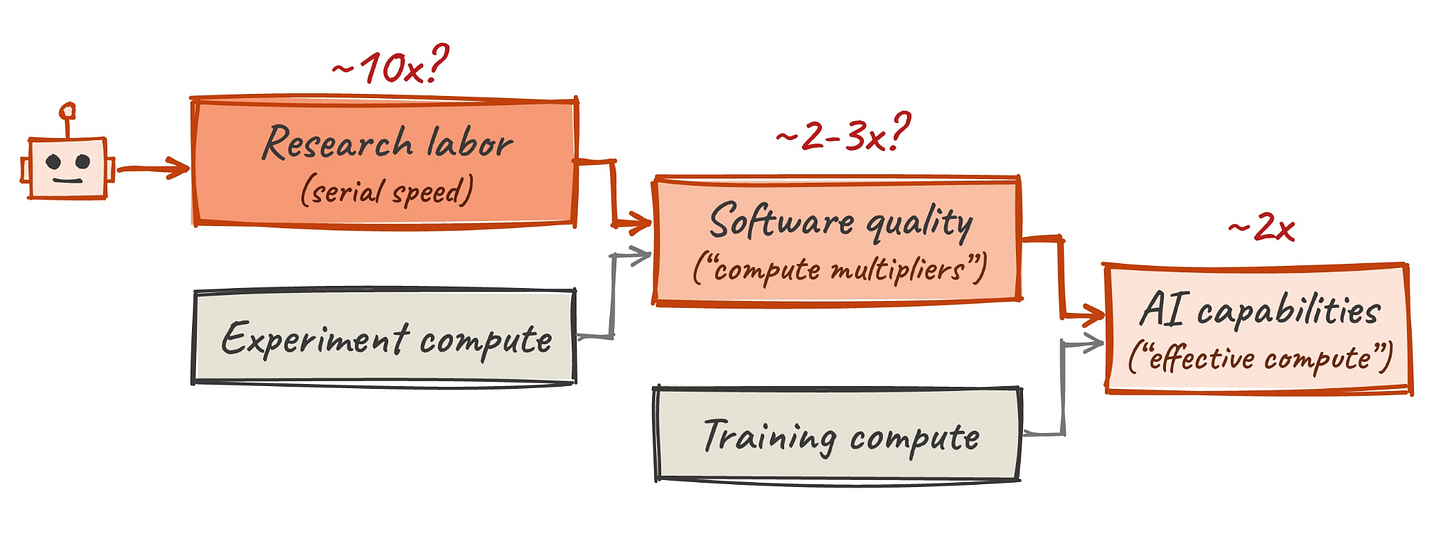
研究人员们在改进算法和架构方面;Anthropic有时会称这些创新为“计算乘数”。整体AI能力(“有效计算”)是计算乘数和训练计算的乘积。由于计算乘数只是能力投入之一,这意味着如果AI能力因软件进展而整体加速两倍,那么计算乘数增长率需要快得多:基于合理假设,可能约为2.5-3倍更快。由于对加速程度和AI贡献的不确定性,我将采用~2-3倍。
类似地,研究人员的劳动只是发现这些计算乘数的一个投入:他们需要测试想法,这需要实验计算。如果假设一个非常简单的Cobb-Douglas模型,实验计算和劳动同样重要,这意味着劳动提升大致需要计算乘数加速的平方。这意味着我们可能需要劳动约*(2-3倍)^2* = 4-9倍 的速度提升,才能使整体AI能力翻倍。然而,一旦能力开始显著加速,这意味着低垂果实以相应更快的速度被采摘。每个新的计算乘数都更需要工作去发现和实施(即“想法变得更难找到”)。在AI加速之前,劳动大致以某种固定指数率通过雇佣更多人类而增长。加上计算增长,这足以补偿diminishing returns足够维持能力进展基线率。但要在不用更快扩展计算的情况下维持新的更快能力进展率,我们需要更快的整体劳动增长率。
由于人类劳动力总增长基本上以旧速率增长,AI提升需要随时间越来越大,才能维持新能力进展率。这意味着今天,在AI加速了几个月后,[9]需要的劳动提升可能需要比最初估计的4-9倍更高,才能使进度翻倍:也许必要的劳动提升约为10倍。这非常不确定,而且更多或更少是可能的。但与Anthropic员工informal self-reports相符:他们说内部模型现在给他们带来约12倍提升。
当你想象10倍提升时,你不应该想象每个研究者现在都是十个研究者的团队——任何做过事的人都知道,十人团队不会每小时获得十倍有价值的工作量。相反,就好像每个Anthropic研究者都身处时间膨胀气泡,经历十天过于外界一天。就好像AI让他们思考、阅读、说话、输入和做其他事情快十倍。Anthropic可能无法通过雇佣任何数量的人来这么快地加速研究。
一个合理的默认期望是,随着AI能力继续改善,AI研究者将从自动化中越来越快地被加速:如果今天他们花一个月才能完成以前一年做的工作,很快可能花一周,然后也许一天。如果这种劳动提升足够强,能克服diminishing returns,那么在其他瓶颈不存在时,将转化为更大的AI进步速度:进度将开始4倍、8倍、16倍,等等。
报告作者对这个问题非常不确定,并说他们的图景多次改变。但最终,他们没有发现会阻碍复合加速的瓶颈或steep diminishing returns的证据。他们还报告看到一些(令人困惑的)redacted evidence,表明加速可能已经超过2倍并随时间增加。
如果我们认真对待 AI现在几乎使AI能力进展翻倍,并假设加速平滑,这朴素地意味着我们一年内达到极超智能。看起来大约一年的AI进步带我们从modest acceleration到AI现在大致以两倍速度进行AI进步。如果AI加速平滑增加,那么在新速度下,我们预计六个月内再次翻倍。届时,又需要三个月翻倍,然后六周。
理论上,这些翻倍时间加起来一年内能力无限。在现实中,我们[达到]软件效率有效上限。但我预计这些限制离我们现在很远。
如果我们走完这个反馈回路,我预计AI系统将能够很快开发新武器,并轻易压倒人类文明。如果这些系统严重misaligned,我认为他们可能[解除人类对权力的控制],这可能导致人类灭绝。
由于AI导致的“大幅加速”是如此重要和极端,因为它是近期极能力的强有力具体指标。事实上,[Anthropic 2025年5月的早期版本]中,最高命名风险阈值AI R&D-5对应一个更弱的里程碑。根据旧RSP,Anthropic在达到AI R&D-5时,至少需要足够安全以“保护抵抗国家级对手模型权重盗窃”。
我同意,对于明年没有非常大的风险杀死十亿人的情况下经历智能爆炸,非常强的安全,包括模型权重和算法秘密本身,是最低要求。AI行业目前远未达到这一标准:
OpenAI和Anthropic最近遭受amateur groups的重大安全漏洞。除了模型权重安全,我们还需要稳健的logging和[监控],覆盖全面,可靠的[monitorability]测量,有效的[monitor collusion]对策,等等。
不幸的是,这些结论的许多重要证据已被redacted。分析选择将不可避免地充满危险,报告作者说证据通常很混乱。我信任同事仔细严谨地处理他们看到的东西,我基于此做了大更新。但我希望更多底层证据透明,这样读者就不用依赖信任。我们可能正在失去时间,在关于timelines和[takeoff speeds]达成共识。当外部科学家不能检查数据和测试自己的模型时,这更难做到。
因为我可能看到了其他机密信息 tha
t might be relevant to timelines and takeoff speeds, I will only discuss implications of public evidence rather than sharing precise bottom line forecasts.
The precise condition is: “*We observe or expect double the rate of progress in AI aggregate capabilities compared to both the rate we’d expect and the fastest rate of extended progress we’ve observed in the absence of significant AI contributions to AI R&D.”
*My understanding is the reason to have both of these conditions (double the rate of progress *both *compared to the counterfactual *and *compared to the fastest sustained rate without much AI assistance) is to exclude cases where the pace of capabilities would have slowed down a lot without AI automation, but we manage to keep the old trends going with dramatic uplift from AI.
The precise condition is: “It is plausible that this doubling is significantly attributable to the automation of research and/or engineering (as opposed to other factors, such as increased headcount, compute, or general productivity), such that continuation of the trend in AI progress seems likely to lead to even greater acceleration.”
The definition of the threshold is a bit finicky, partly because two speedup conditions must be met (speedup relative to the counterfactual and speedup relative to the past). But on a plain reading, my best guess is that it has been met.
The authors of the METR report estimated roughly a doubling in the rate of progress relative to the past, but they only attribute roughly 80% of the current speed-up to AI, which would mean the central estimate for observed speedup relative to no AI was roughly ~1.8x as of the time of writing their report, in October 2026.
But they also found that the contribution of AI has been growing over time, and I would guess that now (as of November 2026) it is appreciably higher. Even if the rate of progress is not fully double the counterfactual right this second, the threshold incorporates reasonable expectations (“We observe or expect double the rate of progress…”).
Anthropic CEO Dario Amodei explains the idea of compute multipliers in this essay: “The field is constantly coming up with ideas, large and small, that make things more effective or efficient: it could be an improvement to the architecture of the model (a tweak to the basic Transformer architecture that all of today’s models use) or simply a way of running the model more efficiently on the underlying hardware. New generations of hardware also have the same effect. What this typically does is shift the curve: if the innovation is a 2x “compute multiplier” (CM), then it allows you to get 40% on a coding task for $5M instead of $10M; or 60% for $50M instead of $100M, etc. Every frontier AI company regularly discovers many of these CM’s: frequently small ones (~1.2x), sometimes medium-sized ones (~2x), and every once in a while very large ones (~10x).”
This is a simplified version of the modeling that my colleague Ryan Greenblatt goes through here. His numbers are based on his prior public modeling of the factors like the importance of software vs training compute and the importance of labor vs experimental compute.
Common formulations of Cobb-Douglas often measure labor as the *number *of humans. In that formulation, there needs to be a parallelization penalty on top of labor and the coefficients don’t add to 1. As I discuss below, I’m choosing to represent labor in terms of serial labor acceleration rather than the number of humans; this formulation was suggested by Ryan Greenblatt in this post.
To make the math simple, I just assumed that labor and experiment compute contributed equally (i.e. compute multipliers = (labor)^0.5 * (compute)^0.5. This means you square the acceleration in compute multipliers to back out the acceleration in labor. The range I gave omits uncertainty on the size of the contributions: for example if labor contributed ⅔, you would instead need to raise it to the power of 3/2.
I say several months rather than a full year because the report authors say that the initial faster progress in late 2025 was in significant part due to other factors, though the *current *speedup is mainly due to AI.