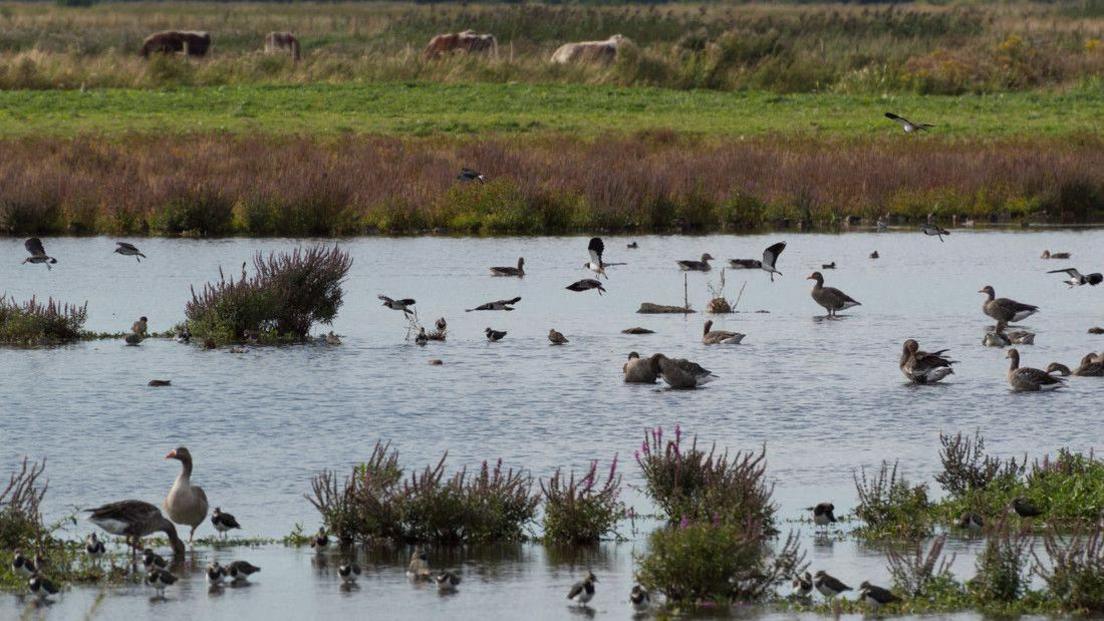
Swans and ducks have enjoyed the wetland reserve at Slimbridge for 80 years
By Dave Harvey
West of England business and environment correspondent
Most people know rainforests are vital in the fight against climate change, but now scientists say wetlands could be even more important.
Saltmarshes, mangrove swamps and wetlands can absorb carbon “four times faster than trees”, according to the charity the Wildfowl and Wetlands Trust (WWT).
Celebrating 80 years since WWT’s first wetland bird reserve was founded at Slimbridge, in Gloucestershire, the charity’s leaders have called for one million hectares of wetlands to be restored across the world.
Sarah Fowler, CEO of WWT, said: “They are mood-boosting, flood-buffering, water-purifying, incredible habitats. But we have lost 85% of the world’s wetlands.”

Sir Peter Scott feeds migrating swans and geese at Slimbridge in 1947, with Desmond Hawkins, BBC features producer from Bristol
WWT now runs 10 wetland bird reserves across the UK.
Many people come to enjoy the swans, geese, flamingoes and migrating wildfowl, but do not realise how powerful these habitats can be in soaking up carbon and slowing down climate change.
So how vital are wetlands for birds, and how powerful can they be in the fight against climate change?
‘Patron Saint of Conservation’
In November 1946, a naturalist called Peter Scott came to a wild marshy area on the banks of the River Severn, near Slimbridge. He was drawn by the thousands of migrating geese and swans that flew thousands of miles from the Russian Arctic to spend the winter here on the mudflats and marshes.
Captivated, Scott settled in a small cottage and later built a house right on a lake, with a huge window to watch the wildfowl.
He dug lakes and connecting channels, built hides and even towers to watch the birds without disturbing them.
Over the years, the reserve grew and became home to thousands of ducks, swans , geese as well as the migrating wildfowl.
 Sir Peter Scott with the first nine Nēnē geese he hand-reared at Slimbridge in 1952
“He really was a pioneer in conservation,” said Chris Moore, a historian of Slimbridge and author of Peter Scott and the Birth of Modern Conservation.
As well as creating a safe haven for endangered species, Scott was a vigorous campaigner for nature.
He led the fight to stop commercial whaling, presented some of the BBC’s first natural history programmes called live from Slimbridge, and helped set up WWF, the World Wildlife Fund.
In 1973 Sir Peter Scott became the first person to be knighted for conservation work.
Moore explained: “Scott was talking about the impact that man was having on the natural world, long before we started talking about climate change and global warming.
“David Attenborough called him the Patron Saint of Conservation, and I think that is more than deserved,” Moore added.
More from Gloucestershire
One of Scott’s typically ambitious projects was to save the Hawaiian Goose, or Nēnē.
Unique to the Pacific islands, the Nēnē was hit hard by road building and development. By 1949 barely 24 birds remained.
Scott heard of its plight, and asked Hawaiian authorities to send a few geese to Slimbridge where he hand-reared them.
“Unfortunately they sent us two females,” chuckled Enid Cole, a WWT volunteer at Slimbridge.
“Peter asked them for a gander - ‘It would help’, he said.”
Nine chicks were later born, and hand-raised successfully to adulthood at Slimbridge.

Dave Harvey helped to feed the Nēnē geese at Slimbridge
Today there are more than 3,000 Nēnē geese, most of them living peacefully on Hawaiian golf courses. But a handful still live at Slimbridge, where Enid Cole and her friends hand feed them lettuce every day.
“It’s a marvelous project, and typical of Sir Peter,” Enid smiled.
Over the last 80 years, the teams at Slimbridge have hand-reared several other species, including the Common Crane and the world’s rarest diving duck, the Madagascan Pochard.
在他们努力拯救马达加斯加麻鸭(Madagascan Pochard)的过程中,他们意识到湿地栖息地是多么重要。
“我们意识到,要拯救这个物种,我们必须让湿地重现生机,”WWT(野生湿地信托基金会)首席执行官莎拉·福勒(Sarah Fowler)解释说。
“而为了让湿地重现生机,我们必须与马达加斯加的整个社区通力合作。”
斯林布里奇(Slimbridge)的志愿管理员伊恩·霍利斯特(Ian Hollister)说:“湿地吸收碳的能力非常强,它们就像一把湿漉漉的秘密武器。”
盐沼“埋藏碳”
科学家们估算,由于沼泽被排干用于农业,以及城市扩张而清除沼泽用于建设,全球已有85%的湿地栖息地丧失。
然而,正如福勒所解释的,“世界上40%的物种依赖湿地栖息地才能生存”。
起步于斯林布里奇(Slimbridge)的这项工作已经推广到英国各地的10个湿地保护区,该慈善机构现在正与地方议会合作恢复湿地,甚至在一些小城市地区也是如此。

WWT(湿地慈善机构)首席执行官莎拉·福勒表示,湿地是“提升情绪、缓冲防洪的栖息地”。
布里斯托尔(Bristol)的一项计划在城市港口停泊了小型的浮动湿地植物岛。
在全球范围内,他们正在发起运动,以恢复一百万公顷丧失的湿地,部分原因是为了给濒危物种提供安全的栖息地,但也是因为湿地吸收碳的速度甚至比森林还要快得多。
“盐沼会埋藏碳,”福勒说。
“每次大潮涨过时,在盐沼中生长的植物都会被埋藏。这些植物富含碳,因此它们是一个巨大的碳汇。”
而盐沼的绝妙之处在于,它们封存碳的速度比树木快四倍。湿地在我们应对气候变化的斗争中至关重要,我们必须恢复它们。”
80年前,这里最初是格洛斯特郡(Gloucestershire)河岸上的一个鸟类保护区,如今已发展成为一项恢复湿地的全球运动,他们将其称为应对气候变化的“湿漉漉的秘密武器”。
联系我们
告诉我们应该在格洛斯特郡报道哪些故事。
关注BBC格洛斯特郡的Facebook、X和Instagram。通过电子邮件或WhatsApp 0800 313 4630向我们发送您的故事创意。