For example, did you know there’s lots of ears in Hamlet? There’s the poison-in-the-ear thing, of course, and characters are always eavesdropping on each other and exhorting each other to listen, but there’s also a lot of talk about ears (“in the porches of my ears”) and number of odd ear-based metaphors (“the whole ear of Denmark”, “like a mildewed ear”). Whether Shakespeare did this on purpose because he had some kind of ear fetish, whether the muse whispered it to him in his sleep (and through what orifice?), and whether any reader notices it—these are all beside the point. The recurrence of these themes and images creates a depth that can be felt even if it isn’t known, and endlessly explored if it is.2
Humans are mortal, for now. This means all of our actions incur opportunity costs, and so the greater the cost paid to create a work of art, the thicker it can get. There’s no guarantee this will happen, of course, and that risk is part of the thrill.
The Met Cloisters has these wooden altarpieces from the 1400s that draw your attention immediately, I think because the mind can subconsciously calculate the time it must have taken to carve them, and it sends a signal back to the eyes: important. You know that you are not just seeing a work of art, but the expenditure of a life.
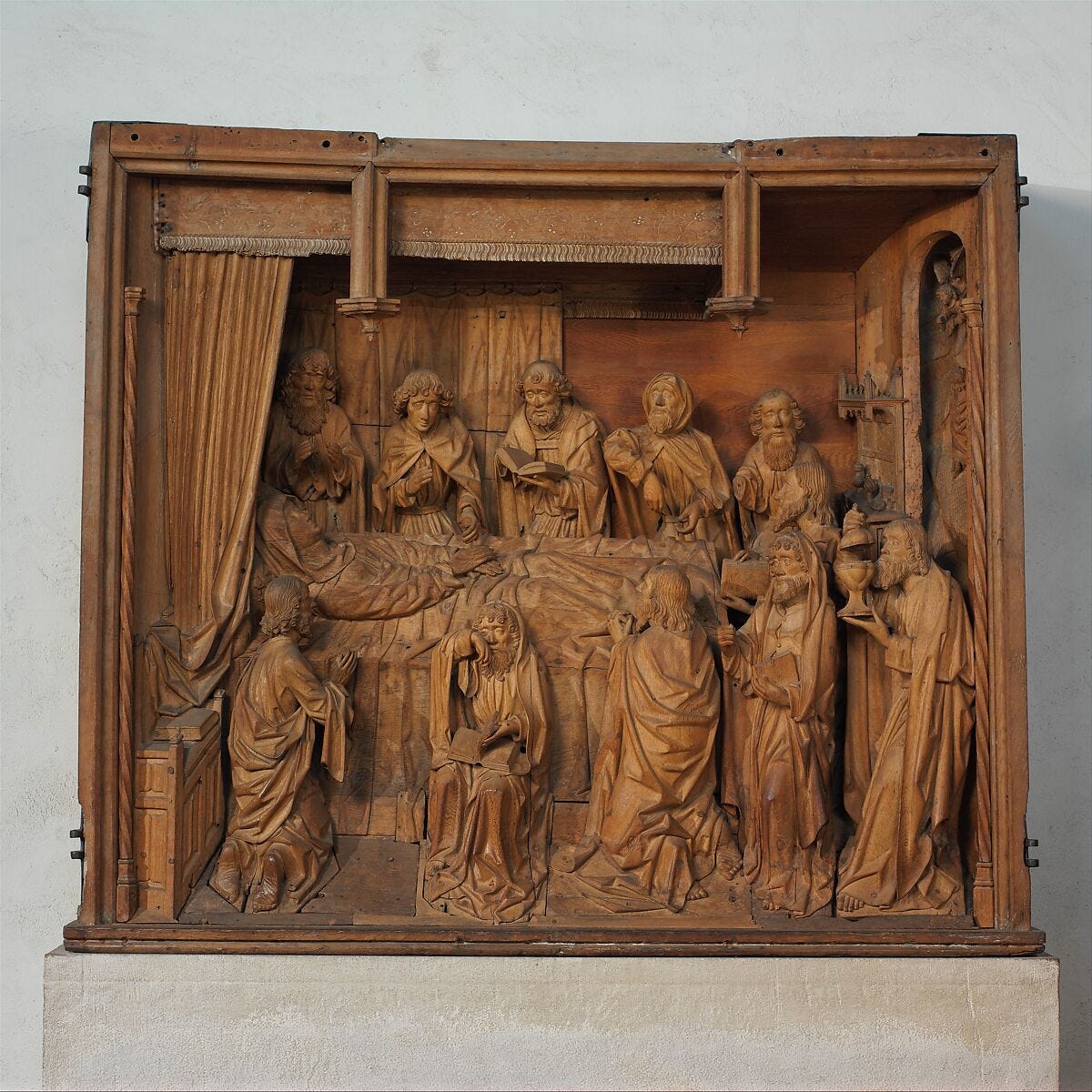
(source)
Here’s an even more haunting example. I once saw the magician duo Penn and Teller perform live, and at the end of the show, Penn told us he was going to swallow fire. As he dipped the torch in gasoline, he explained that what he was about to show us is not a trick. Magicians are always saying things like that, but in this case it’s true: there is no sleight of hand the protects the fire-eater from the flames. They get blisters and burns, the fuel drips down their esophagus and poisons them, they suck the hydrocarbons into their lungs and contract “fire-eater’s pneumonia”. To watch someone eat fire is to watch someone shorten their lifespan for your entertainment.
“When you leave the theater tonight, you’re going to ask yourselves, ‘How did they do it?’”, Penn said as he lit the torch. “Instead, I’d like you to ask yourselves, ‘*Why *did they do it?’“ And then he reared his head back and swallowed the flame.
The other way to understand thickness is to study its absence.
Guys who work in bike shops like to joke about bicycle-shaped objects—sure, that mass-produced hunk of metal and plastic has a seat, pedals, wheels, and handlebars, but that doesn’t mean it’s a bike. When the materials are so cheap and the construction is so slapdash, it deserves another name entirely.
This terminology comes in handy, because it turns out there are also movie-shaped objects and book-shaped objects, art-shaped objects and thought-shaped objects. Just because a series of pictures flickered across the screen and the credits followed, that doesn’t mean it was a movie. Just because it’s printed out and bound in cardboard, that doesn’t mean it’s a book. There is an additional essence that is necessary to turn something from the shape of a thing into the actual thing, and the difference between having and lacking that essence is the difference between a corpse and a person.
This essence is what makes fiction worth reading in the first place, but it’s hard to capture in a paragraph, so let me show you some nonfiction instead, where you can spot the thinness in an instant. Here’s a passage from a self-help book that a friend sent me recently:
You are built to perform under pressure and that is exactly what you will do. Reminding yourself of this changes the meaning of those signs of stress that might otherwise be seen as “symptoms” of a problem. In fact, research shows that simply reminding someone that their performance improves under pressure improves their actual performance by 33 percent (Jamieson et al., 2018).
These sentences crumble immediately upon inspection. First of all, there’s something embarrassing and grating about getting generic encouragement from a book—you don’t know me! Maybe I am not “built to perform under pressure”! I might be a pathetic weakling who is destined to choke at the pivotal moment. What then?
Plus, the facts here are brittle. I looked up the paper in question and could not find this “33 percent” number anywhere. Maybe it’s made up? And what is “performance”, anyway? Performance on anything? Surely not; the studies cited in the paper are mainly about taking multiple-choice tests.3 This is exactly the kind of finding that rises to prominence thanks to one small and flawed experiment, attracts a bunch of excited research, gets wildly overgeneralized under the handwavy phrase “studies show”, and then shrivels under a wave of debunkings and non-replications, such that after years of work, the whole thing ends with an embarrassed shrug. (Unsurprisingly, there is some evidence of publication bias for this “built to perform under pressure” effect.)
Reading a book like this feels like wandering through a Potemkin village. Touch any of the ideas, and they tip over.
In nonfiction, it might seem like the solution for puffery is pedantry, as if thickness comes from presenting every relevant fact in agonizing detail. But it doesn’t, just as thickness in fiction doesn’t come from describing every object in the room before you let the characters open their mouths. Instead, thickness comes from surfacing a few facts well, and in such a way that you realize the existence of entire universes of additional facts that *could *be known.
For example, here’s a short passage from Jane Jacobs’ The Death and Life of Great American Cities:
[City planners] operate on the premise that city people seek the sight of emptiness, obvious order and quiet. Nothing could be less true. People’s love of watching activity and other people is constantly evident in cities everywhere. This trait reaches an almost ludicrous extreme on upper Broadway in New York, where […] benches have been placed behind big concrete buffers and on any day when the weather is even barely tolerable these benches are filled with people at block after block after block, watching the pedestrians who cross the mall in front of them, watching the traffic, watching the people on the busy sidewalks, watching each other.
Jacobs notes that further north, near Columbia University, the streets are quieter, the pedestrians are more orderly, the traffic is calmer…and the benches are empty. “I have tried them and can see why,” Jacobs says. “No place could be more boring.”4
There are a lot of threads here, so I’ll pick just one. Jacobs is pointing out a fact that millions of people observe every day, but almost none of them notice. Including me! I once lived on those boring blocks that Jacobs describes, and although I noticed something amiss—I would tell friends I lived in “the dead zone of Manhattan”—I never understood why. Nor do I think psychologists really have an answer for *what *motivates people to sit on benches and watch other humans go by. What drive is this satisfying?
There is a danger, of course, in seeking and praising thickness, one that even I understood when I was a barely-sentient teenager. If you allow for the existence of secret treasures that can only be accessed with effort and analysis, then you empower the elitists and the snobs. “Buddy, don’t even *talk *to me until you’ve been in the cave!”
But look around. The snobs are in full retreat. We have swung the pendulum so far toward poptimism, toward the blinkered idea that all art is equal because all humans are equal, toward the ethos that guilty pleasures are simply pleasures, that I’m not sure if we can ever swing it back.
Erasing the line between the thick and the thin has left us defenseless against slop at the exact moment of its onslaught. Everyone can sense there’s something amiss with the prose that comes out of the machines, but we lack the language to talk about it, and so we’ve converged on the idea that slop simply means using too many em dashes, bullet points, and line breaks.
No, what separates substance from slop is thickness. Slop holds no secrets; it signifies nothing. Under scrutiny, it evaporates. All it can offer is bottomlessness—sure, there’s nothing on, but at least there are infinite channels!
That’s why I’m neither surprised nor dismayed when studies find that people prefer AI art to human art. Of course they do! In the short term, thinness prevails. When people are making snap judgments, they want pretty flowers, poems that rhyme, pleasing pablum, the simulacrum of thought.5 But none of these last. The real question is not “which of these things looks nicer when you look at them for two seconds?” but “which of these things will stand the test of time?” Which of them will people fly across the world to see? Which of them will drive people so mad they’ll major in the humanities?
This kind of quality can only be proven by longevity. Which answers another question I had when I was scowling in the back of English class: why do we have to spend so much time reading *old *stuff? And the answer is: this is the only stuff that we can be sure is any good. Great works of art, like successful genes, convince humans to keep passing them on. If something has survived for centuries, then there’s probably something to it. We’re not still brewing Bronze Age beer and we’re not still sailing Bronze Age ships, but we are still telling Bronze Age stories, and this warrants our attention.
Speaking of longevity, remember a few months ago, when everyone was Studio Ghibli-fying all the pictures in their camera roll? Well, why did they stop? Why are those millions of images gathering dust in a data center while people continue to watch actual Studio Ghibli films? Why is it that Suno can AI-generate you any kind of music you want, but if you go on the Suno Reddit, you’ll find a running joke that no one can stand anyone’s Suno music but their own—a quality that, I can’t help but mention, also applies to farts?
The slop-acalypse that so many of us fear, when people will stop looking at anything made by humans and only look at things made by machines—why hasn’t that happened yet? Do the models need another million tokens? Are we still looking for the right prompts? Or could it be that we are attempting to mass-produce something that cannot be mass-produced?
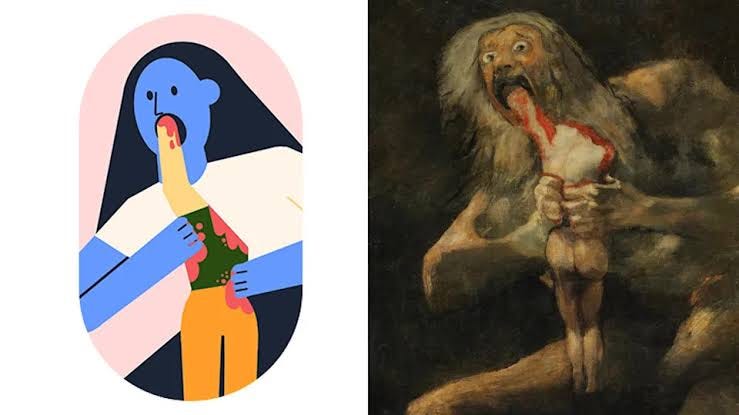
On the left: @clayohr on twitter. On the right: Francisco Goya.
Regardless, people keep trying. About once a week, I get a pitch from some AI startup that wants to automate some part of my writing. The most recent one says it’s “built for credible thinkers who have a book’s worth of ideas but not the time it typically takes to write one”.
I’m sorry, but if you’re building or using a tool like this, then you’ve got slop for brains. There is no such thing as having a “book’s worth of ideas” that are all ready to go except for the small matter of choosing the right words and putting them in the right order.
I know exactly the feeling that these slop-trepeneurs are preying on, because I feel it all the time: I’ve got these thoughts in my head, and boy oh boy they’re good ones, all-timers, really, and it’s so annoying that I have to spend all this time making the words sound good, when the ideas behind the words are *already *so good!
But this is an illusion. The ideas are not already good. They need to be thickened. I understand why it’s tempting to force a machine do the hard part for you, but it can’t, and the hard part is the only part worth doing anyway. Making something thick—that’s a lot of pressure! But remember: you were built to perform under pressure, and that’s just what you’ll do.
*Experimental History *would trade its life for your entertainment
These images come from this article, which was referenced in this tweet, which was picked up in this post, which is where I found it.
I first learned of this example from Nabeel S. Qureshi’s What Makes Art Great?, which is another good take on this topic.
Also, those studies did not remind participants “that their performance improves under pressure”—they told participants that feeling anxious during a test doesn’t mean you will necessarily perform worse, and it might make you perform better.
For another take on this, see Max Read’s “People prefer A.I. art because people prefer bad art”.
658
85
138
Share
Previous
Discussion about this post
CommentsRestacks

[

](https://substack.com/profile/25714999-karen-in-montreal?utm_source=comment)
Liked by Adam Mastroianni
One of my high school English teachers got this point across to us in such an effective way! All year we read ‘great’ books, discussed, analyzed, wrote essays, etc. Then with about a month left, we read a thriller that was on the best seller lists at the time, had been for months. The teacher presented it as both an opportunity to read something we (the students) would be more likely to approach with enthusiasm, and to apply our new analytic abilities to something more recent.
As you can imagine, we all started out with happy anticipation. Deflated so quickly. It was, of course, dreck. We came to class and said so. The teacher had us tell him WHY it was dreck, what was different from the (highly varied) books we’d been reading the rest of the year, what made it so … disappointing. We analyzed that dreck as hard as we had the ‘classics’.
And on that note, a couple of years ago I finally read ‘Middlemarch’. OMG! Why did I wait so long! I’ve already re-read it once.
(Still can’t stand Charles Dickens, though ….)
Reply
Share
2 replies by Adam Mastroianni and others
[

](https://substack.com/profile/46245534-rebekah-in-the-abstract?utm_source=comment)
Liked by Adam Mastroianni
“But this is an illusion. The ideas are not already good. They need to be thickened.”
In my own experience of art-making (fiction and music), the initiating ideas in and of themselves are not only insufficient until I’ve done the work of constructing and communicating them, but they aren’t even really all that clearly “mine.” The best things I’ve made started with ideas that just sort of popped into my mind while I was falling asleep or something like that. The whole process of execution is the part that I really have organized conscious agency over. That process is where I figure out how to make it compelling and rewarding for others, but it’s also where I figure out for myself just what the “idea” really is. It’s a remarkable process, simultaneously self-discovering and connective. Basically every other creative person I know feels the same way. The pitch that we could outsource that part of the work is simply not tempting at all.
Reply
Share
TopLatestDiscussions
No posts
Start your SubstackGet the app
Substack is the home for great culture
window.__staticRouterHydrationData = JSON.parse("{"loaderData":{},"actionData":null,"errors":null}");
window.Sentry && window.Sentry.onLoad(function() { window.Sentry.init({ environment: window._preloads.sentry_environment, dsn: window._preloads.sentry_dsn, }) })
window.preloads = JSON.parse("{"isEU":false,"language":"en","country":"JP","leaderboardCountries":["ES","FR","GB","IT","NL"],"enabledLeaderboardCountries":["ES","FR","GB","IT","NL"],"userLocale":{"language":"en","region":"US","source":"default"},"base_url":"https://www.experimental-history.com","stripe_publishable_key":"pk_live_51QfnARLDSWi1i85FBpvw6YxfQHljOpWXw8IKi5qFWEzvW8HvoD8cqTulR9UWguYbYweLvA16P7LN6WZsGdZKrNkE00uGbFaOE3","captcha_site_key":"6LeI15YsAAAAAPXyDcvuVqipba_jEFQCjz1PFQoz","pub":{"apple_pay_disabled":false,"apex_domain":"experimental-history.com","author_id":69354522,"byline_images_enabled":true,"bylines_enabled":true,"chartable_token":null,"community_enabled":true,"copyright":"Adam Mastroianni","cover_photo_url":"https://bucketeer-e05bbc84-baa3-437e-9518-adb32be77984.s3.amazonaws.com/public/images/f00f3e4a-0a4e-4cd2-b889-b0b193786425_1280x818.png","created_at":"2021-12-31T04:26:10.222Z","custom_domain_optional":false,"custom_domain":"www.experimental-history.com","default_comment_sort":"best_first","default_coupon":null,"default_group_coupon":null,"default_show_guest_bios":true,"email_banner_url":null,"email_from_name":"Adam Mastroianni","email_from":null,"embed_tracking_disabled":false,"explicit":false,"expose_paywall_content_to_search_engines":true,"fb_pixel_id":null,"fb_site_verification_token":null,"flagged_as_spam":false,"founding_subscription_benefits":["I’ll send Founding Members something extra special. Only choose this tier if $500 isn’t that much for you."],"free_subscription_benefits":["My scientific research and long essays will always be open to everyone"],"ga_pixel_id":"G-TNWW0CPTJL","google_site_verification_token":null,"google_tag_manager_token":"G-TNWW0CPTJL","hero_image":null,"hero_text":"1) Find what’s true and make it useful. 2) Publish every other Tuesday. 3) Photo cred: my dad.","hide_intro_subtitle":null,"hide_intro_title":null,"hide_podcast_feed_link":false,"homepage_type":"newspaper","id":656797,"image_thumbnails_always_enabled":false,"invite_only":false,"hide_podcast_from_pub_listings":false,"language":"en","logo_url_wide":null,"logo_url":"https://substackcdn.com/image/fetch/$s!VtWA!,f_auto,q_auto:good,fl_progressive:steep/https%3A%2F%2Fbucketeer-e05bbc84-baa3-437e-9518-adb32be77984.s3.amazonaws.com%2Fpublic%2Fimages%2Fe1a1b3b4-5f35-4876-a0d5-449398201e1f_1171x1171.png","minimum_group_size":2,"moderation_enabled":true,"name":"Experimental History","paid_subscription_benefits":["MYSTERY POSTS\u2013\u2013extra content for paid subscribers only","You vote for a world where Experimental History exists"],"parsely_pixel_id":null,"chartbeat_domain":null,"payments_state":"enabled","paywall_free_trial_enabled":false,"podcast_art_url":null,"paid_podcast_episode_art_url":null,"podcast_byline":null,"podcast_description":null,"podcast_enabled":false,"podcast_feed_url":null,"podcast_title":null,"post_preview_limit":null,"primary_user_id":69354522,"require_clickthrough":false,"show_pub_podcast_tab":false,"show_recs_on_homepage":true,"subdomain":"experimentalhistory","subscriber_invites":0,"support_email":null,"theme_var_background_pop":"#2EE240","theme_var_color_links":false,"theme_var_cover_bg_color":null,"trial_end_override":null,"twitter_pixel_id":null,"type":"newsletter","post_reaction_faces_enabled":true,"is_personal_mode":false,"plans":[{"id":"monthly10usd","object":"plan","active":true,"aggregate_usage":null,"amount":1000,"amount_decimal":"1000","billing_scheme":"per_unit","created":1673359256,"currency":"usd","interval":"month","interval_count":1,"livemode":true,"metadata":{"substack":"yes"},"meter":null,"nickname":"$10 a month","product":"prod_N90OwYlUBi7XKT","tiers_mode":null,"transform_usage":null,"trial_period_days":null,"usage_type":"licensed","currency_options":{"aud":{"custom_unit_amount":null,"tax_behavior":"unspecified","unit_amount":1500,"unit_amount_decimal":"1500"},"brl":{"custom_unit_amount":null,"tax_behavior":"unspecified","unit_amount":5500,"unit_amount_decimal":"5500"},"cad":{"custom_unit_amount":null,"tax_behavior":"unspecified","unit_amount":1500,"unit_amount_decimal":"1500"},"chf":{"custom_unit_amount":null,"tax_behavior":"unspecified","unit_amount":900,"unit_amount_decimal":"900"},"dkk":{"custom_unit_amount":null,"tax_behavior":"unspecified","unit_amount":7000,"unit_amount_decimal":"7000"},"eur":{"custom_unit_amount":null,"tax_behavior":"unspecified","unit_amount":900,"unit_amount_decimal":"900"},"gbp":{"custom_unit_amount":null,"tax_behavior":"unspecified","unit_amount":800,"unit_amount_decimal":"800"},"inr":{"custom_unit_amount":null,"tax_behavior":"unspecified","unit_amount":96000,"unit_amount_decimal":"96000"},"jpy":{"custom_unit_amount":null,"tax_behavior":"unspecified","unit_amount":1700,"unit_amount_decimal":"1700"},"mxn":{"custom_unit_amount":null,"tax_behavior":"unspecified","unit_amount":17500,"unit_amount_decimal":"17500"},"nok":{"custom_unit_amount":null,"tax_behavior":"unspecified","unit_amount":10000,"unit_amount_decimal":"10000"},"nzd":{"custom_unit_amount":null,"tax_behavior":"unspecified","unit_amount":1800,"unit_amount_decimal":"1800"},"pln":{"custom_unit_amount":null,"tax_behavior":"unspecified","unit_amount":3800,"unit_amount_decimal":"3800"},"sek":{"custom_unit_amount":null,"tax_behavior":"unspecified","unit_amount":10000,"unit_amount_decimal":"10000"},"usd":{"custom_unit_amount":null,"tax_behavior":"unspecified","unit_amount":1000,"unit_amount_decimal":"1000"}}},{"id":"yearly100usd","object":"plan","active":true,"aggregate_usage":null,"amount":10000,"amount_decimal":"10000","billing_scheme":"per_unit","created":1673359257,"currency":"usd","interval":"year","interval_count":1,"livemode":true,"metadata":{"substack":"yes"},"meter":null,"nickname":"$100 a year","product":"prod_N90OBhoHoHRaRV","tiers_mode":null,"transform_usage":null,"trial_period_days":null,"usage_type":"licensed","currency_options":{"aud":{"custom_unit_amount":null,"tax_behavior":"unspecified","unit_amount":14500,"unit_amount_decimal":"14500"},"brl":{"custom_unit_amount":null,"tax_behavior":"unspecified","unit_amount":51500,"unit_amount_decimal":"51500"},"cad":{"custom_unit_amount":null,"tax_behavior":"unspecified","unit_amount":14500,"unit_amount_decimal":"14500"},"chf":{"custom_unit_amount":null,"tax_behavior":"unspecified","unit_amount":8500,"unit_amount_decimal":"8500"},"dkk":{"custom_unit_amount":null,"tax_behavior":"unspecified","unit_amount":65500,"unit_amount_decimal":"65500"},"eur":{"custom_unit_amount":null,"tax_behavior":"unspecified","unit_amount":9000,"unit_amount_decimal":"9000"},"gbp":{"custom_unit_amount":null,"tax_behavior":"unspecified","unit_amount":7500,"unit_amount_decimal":"7500"},"inr":{"custom_unit_amount":null,"tax_behavior":"unspecified","unit_amount":957500,"unit_amount_decimal":"957500"},"jpy":{"custom_unit_amount":null,"tax_behavior":"unspecified","unit_amount":16500,"unit_amount_decimal":"16500"},"mxn":{"custom_unit_amount":null,"tax_behavior":"unspecified","unit_amount":175000,"unit_amount_decimal":"175000"},"nok":{"custom_unit_amount":null,"tax_behavior":"unspecified","unit_amount":96500,"unit_amount_decimal":"96500"},"nzd":{"custom_unit_amount":null,"tax_behavior":"unspecified","unit_amount":17500,"unit_amount_decimal":"17500"},"pln":{"custom_unit_amount":null,"tax_behavior":"unspecified","unit_amount":38000,"unit_amount_decimal":"38000"},"sek":{"custom_unit_amount":null,"tax_behavior":"unspecified","unit_amount":97000,"unit_amount_decimal":"97000"},"usd":{"custom_unit_amount":null,"tax_behavior":"unspecified","unit_amount":10000,"unit_amount_decimal":"10000"}}},{"id":"founding50000usd","name":"founding50000usd","nickname":"founding50000usd","active":true,"amount":50000,"currency":"usd","interval":"year","interval_count":1,"metadata":{"substack":"yes","founding":"yes","no_coupons":"yes","short_description":"Founding Member","short_description_english":"Founding Member","minimum":"50000","minimum_local":{"usd":50000,"gbp":37000,"eur":43000,"cad":69500,"mxn":847500,"aud":70500,"brl":259000,"sek":472000,"chf":40000,"dkk":320500,"nok":466500,"inr":4777500,"jpy":79500,"nzd":84500,"pln":185000}},"currency_options":{"usd":{"unit_amount":50000,"tax_behavior":"unspecified"},"gbp":{"unit_amount":37000,"tax_behavior":"unspecified"},"eur":{"unit_amount":43000,"tax_behavior":"unspecified"},"cad":{"unit_amount":69500,"tax_behavior":"unspecified"},"mxn":{"unit_amount":847500,"tax_behavior":"unspecified"},"aud":{"unit_amount":70500,"tax_behavior":"unspecified"},"brl":{"unit_amount":259000,"tax_behavior":"unspecified"},"sek":{"unit_amount":472000,"tax_behavior":"unspecified"},"chf":{"unit_amount":40000,"tax_behavior":"unspecified"},"dkk":{"unit_amount":320500,"tax_behavior":"unspecified"},"nok":{"unit_amount":466500,"tax_behavior":"unspecified"},"inr":{"unit_amount":4777500,"tax_behavior":"unspecified"},"jpy":{"unit_amount":79500,"tax_behavior":"unspecified"},"nzd":{"unit_amount":84500,"tax_behavior":"unspecified"},"pln":{"unit_amount":185000,"tax_behavior":"unspecified"}}}],"stripe_user_id":"acct_1MFemWDw9iCwgFVq","stripe_country":"US","stripe_publishable_key":"pk_live_51MFemWDw9iCwgFVqxtgY7x70DrQYiiP61T0vfcv8DdWFyBYU1KbGA7pEOzWTDG8nMuKDkcuWL38nZd6oDxkNRnDT000pIuixik","stripe_platform_account":"US","automatic_tax_enabled":false,"author_name":"Adam Mastroianni","author_handle":"experimentalhistory","author_photo_url":"https://substackcdn.com/image/fetch/$s_!5WuG!,f_auto,q_auto:good,fl_progressive:steep/https%3A%2F%2Fbucketeer-e05bbc84-baa3-437e-9518-adb32be77984.s3.amazonaws.com%2Fpublic%2Fimages%2F5cfa0b33-de32-41f5-b53a-9b7f33c7f68f_1832x1171.jpeg","author_bio":"I study people.","twitter_screen_name":"a_m_mastroianni","has_custom_tos":false,"has_custom_privacy":false,"theme":{"background_pop_color":"#E69F00","web_bg_color":"#ffffff","cover_bg_color":null,"publication_id":656797,"color_links":null,"font_preset_heading":null,"font_preset_body":null,"font_family_headings":null,"font_family_body":null,"font_family_ui":null,"font_size_body_desktop":null,"print_secondary":null,"custom_css_web":null,"custom_css_email":null,"home_hero":"newspaper","home_posts":"list","home_show_top_posts":false,"hide_images_from_list":false,"home_hero_alignment":"left","home_hero_show_podcast_links":true,"default_post_header_variant":null,"custom_header":null,"custom_footer":null,"social_media_links":null,"font_options":null,"section_template":null,"custom_subscribe":null,"design_template":null,"design_template_options":null},"threads_v2_settings":null,"default_group_coupon_percent_off":null,"default_group_coupon_include_founding":null,"pause_return_date":null,"has_posts":true,"has_recommendations":true,"first_post_date":"2022-01-01T15:55:23.613Z","has_podcast":false,"has_free_podcast":false,"has_subscriber_only_podcast":false,"has_community_content":true,"rankingDetail":"Thousands of paid subscribers","rankingDetailFreeIncluded":"Tens of thousands of subscribers","rankingDetailOrderOfMagnitude":1000,"rankingDetailFreeIncludedOrderOfMagnitude":10000,"rankingDetailFreeSubscriberCount":"Over 97,000 subscribers","rankingDetailByLanguage":{"ar":{"rankingDetail":"\u0622\u0644\u0627\u0641 \u0627\u0644\u0645\u0634\u062A\u0631\u0643\u064A\u0646 \u0627\u0644\u0645\u062F\u0641\u0648\u0639\u064A\u0646"},"ca":{"rankingDetail":"Milers de subscriptors de pagament"},"da":{"rankingDetail":"Tusindvis af betalte abonnenter"},"de":{"rankingDetail":"Tausende von Paid-Abonnenten"},"es":{"rankingDetail":"Miles de suscriptores de pago"},"fr":{"rankingDetail":"Plusieurs milliers d\u2019abonn\u00E9s payants"},"ja":{"rankingDetail":"\u6570\u5343\u4EBA\u306E\u6709\u6599\u767B\u9332\u8005"},"nb":{"rankingDetail":"Tusenvis av betalende abonnenter"},"nl":{"rankingDetail":"Duizenden betalende abonnees"},"pl":{"rankingDetail":"Tysi\u0105ce p\u0142ac\u0105cych subskrybent\u00F3w"},"pt":{"rankingDetail":"Milhares de subscri\u00E7\u00F5es pagas"},"pt-br":{"rankingDetail":"Milhares de assinantes pagas"},"en-gb":{"rankingDetail":"Thousands of paid subscribers"},"it":{"rankingDetail":"Migliaia di abbonati a pagamento"},"tr":{"rankingDetail":"Binlerce \u00FCcretli abone"},"sv":{"rankingDetail":"Tusentals betalande prenumeranter"},"fi":{"rankingDetail":"Thousands of paid subscribers"},"is":{"rankingDetail":"Thousands of paid subscribers"},"en":{"rankingDetail":"Thousands of paid subscribers"}},"freeSubscriberCount":"97,000","freeSubscriberCountOrderOfMagnitude":"97K+","author_bestseller_tier":1000,"author_badge":{"type":"bestseller","tier":1000},"disable_monthly_subscriptions":false,"disable_annual_subscriptions":false,"hide_post_restacks":false,"notes_feed_enabled":false,"showIntroModule":false,"isPortraitLayout":false,"last_chat_post_at":null,"primary_profile_name":"Adam Mastroianni","primary_profile_photo_url":"https://substackcdn.com/image/fetch/$s_!5WuG!,f_auto,q_auto:good,fl_progressive:steep/https%3A%2F%2Fbucketeer-e05bbc84-baa3-437e-9518-adb32be77984.s3.amazonaws.com%2Fpublic%2Fimages%2F5cfa0b33-de32-41f5-b53a-9b7f33c7f68f_1832x1171.jpeg","no_follow":false,"sponsorshipCampaigns":{},"paywall_chat":"free","sections":[],"podcastTabInfo":null,"multipub_migration":null,"navigationBarItems":[{"id":"2c57e7a1-6792-4b1e-a021-c6737dbafee1","publication_id":656797,"sibling_rank":0,"link_title":"MYSTERY POSTS","link_url":"","section_id":null,"post_id":null,"is_hidden":null,"standard_key":null,"post_tag_id":"d597bc9e-9730-4f1e-a8bf-e8cec8bcc388","parent_id":null,"is_group":false,"post":null,"section":null,"postTag":{"id":"d597bc9e-9730-4f1e-a8bf-e8cec8bcc388","publication_id":656797,"name":"MYSTERY POSTS","slug":"mystery-posts","hidden":false},"children":[]}],"has_active_perks":false,"contributors":[{"name":"Adam Mastroianni","handle":"experimentalhistory","role":"admin","owner":true,"user_id":69354522,"photo_url":"https://substackcdn.com/image/fetch/$s_!5WuG!,f_auto,q_auto:good,fl_progressive:steep/https%3A%2F%2Fbucketeer-e05bbc84-baa3-437e-9518-adb32be77984.s3.amazonaws.com%2Fpublic%2Fimages%2F5cfa0b33-de32-41f5-b53a-9b7f33c7f68f_1832x1171.jpeg","bio":"I study people.","status":{"bestsellerTier":1000,"subscriberTier":5,"leaderboard":null,"vip":false,"badge":{"type":"bestseller","tier":1000},"subscriber":null}}],"threads_v2_enabled":false,"viralGiftsConfig":null,"no_index":false,"tier":2,"can_set_google_site_verification":true,"can_have_sitemap":true,"iap_advanced_plans":[{"sku":"pNEwKdb2OeefTKZgOS","publication_id":"656797","is_active":true,"price_base_units":1400,"currency_alpha3":"usd","period":"month","created_at":"2025-08-18T15:12:36.650Z","photo cred: my dad
I owe an apology to every English teacher I ever had. I always assumed that so-called \u201Cgreat\u201D literature was a hoax, a punishment inflicted upon adolescents for the crime of being young. These books did not have anything special about them, and covering up that fact was simply a make-work exercise for former English majors, a sort of \u201Cjobs for snobs\u201D program.
I was wrong about this. There is such thing as greatness. More specifically, there is such thing as thickness. Great works of fiction\u2014for that matter, great works of any art\u2014unfurl in response to your attention. The more time you spend with them, the more you get out of them. That kind of responsiveness is so addicting that it can lead people to do crazy things, like try to teach literature to high schoolers.
But thickness is tricky, because rewarding the careful reader often means repelling the casual one. And this is where I would like an apology in return from my English teachers, because while this might have been obvious to them, they never made it obvious to me.
I was presented with art and literature as if it was self-explanatory, and that everything wonderful about it was plainly visible from the outside. But those works were much more like dark, winding caves with treasure stashed inside of them. My teachers were like, \u201CRight, well, into the cave you go!\u201D and I was like \u201CBut there\u2019s nothing in there\u201D and they were like \u201CEntering the cave is 30% of your grade\u201D and so I took a few steps into the darkness and I was like \u201CJust as I suspected: an empty cave\u201D and then I came trudging back out and pretended that I saw something.
But if someone had outfitted me appropriately, if they warned me that you have to bring one of those crank-up flashlights and you might have to shimmy through some narrow antechambers and spelunk through some flooded passageways, but that eventually you would reach a room full of untold riches\u2014well, maybe I would have actually tried.
Instead, I had to learn about thickness by looking at a guy\u2019s butt.
For most of my life, I treated art museums like celebrity scavenger hunts. The point of visiting was to see in person the thing you had seen on a screen or in a book; the goal was collection rather than contemplation. And so I would power-walk through the galleries, scanning the placards for famous names, rushing over whenever one of my companions would hiss, \u201COh, this one\u2019s a Van Gogh!\u201D
This ended when I encountered The Garden of Earthly Delights, a triptych painted by the Dutch master Hieronymous Bosch. When I went to collect that one, I got stuck. I wanted to stand in front of it forever.
It\u2019s a painting from 500 years in the past that looks like a painting from 500 years in the future. Every corner of it is filled with \u201Cfreakish riddles\u201D and \u201Cirresponsible phantasmagoria\u201D, in the words of art critic Wilhelm Fr\u00E4nger. For example, what is going on with this dude?
In the third panel of the triptych, there\u2019s a scene of some instruments, some naked dudes, and some kind of pink demon with an alarmingly long tongue. Look closely, and you\u2019ll see one of the naked dudes has some music printed on his butt (helpfully, one of his friends is pointing at it, as if to say, \u201Cdude you have some music on your butt\u201D).
In 2012, a student at Oklahoma Christian University named Amelia Hamrick noticed the butt music and decided to transcribe it, record it, and post it to her blog, catapulting her to instant worldwide fame.
You can listen to her version here, though of course it sounds better played on the hurdy-gurdy.
When I started writing this section, I intended to include this fact as a fun little Easter egg\u2014look how thick this painting is, that it goes to the trouble of writing an actual song on a guy\u2019s hiney!
But it turns out I got this all wrong, and the painting was even thicker than I thought. While researching the story, I stumbled upon three magisterial blog posts by Ian Pittman, an expert on medieval music. He argues:
Hamrick was not the first to resurrect the butt music. It was also done by the Swedish group Vox Vulgaris in 2003, Atrium Musicae in 1978 (from the LP Codex Gluteo), and, according to a now-deleted angry comment, by some art history professors in 1981 and 1961, whose erasure from this story has left them quite, if you will, butthurt.
The butt music is not music at all. It lacks a clef, the notes are spaced out randomly, and one of the staffs has a different number of lines. If you try to turn it into a coherent song, you\u2019re basically making things up\u2014or as we would call it if an LLM did it, hallucinating. (Perhaps this is why every rendition of the butt music has sounded so different.)
Bosch *intended *the butt music to be unplayable. If you look across his works, understand the context of his life, and spend a little extra time inspecting The Garden of Earthly Delights, you realize that Bosch thought secular music was a one-way ticket to hell. (Church music was a-ok, as long as it was for the glory of god and not the glory of the players.) That\u2019s why he depicted so many musicians being tortured: one of them is trapped inside a drum that\u2019s being beaten by some kind of raccoon demon, another is being crucified on a harp, and the butt music guy himself is being crushed by a giant lute. For Bosch, putting actual music on a guy\u2019s ass would be like the FBI handing out copies of the Anarchist Cookbook.
So the butt music is not a secret, but a warning: \u201CIf you play music outside of a church context, demons will torture you for eternity.\u201D I find this funny, because I grew up amidst a moral panic over rap music; just imagine growing up in a moral panic over *all *music. \u201COh, your heart will go on, Celine Dion? No, your heart will be torn from your chest and fed to the slavering servants of Beelzebub.\u201D
So that\u2019s what thickness *looks *like, but what *is *it? What makes something thick?
There is no straightforward answer to this question, which is what makes thickness both rare and remarkable in the first place. But I think there are four thickening agents worth considering:
Thick art bears the marks of approaches attempted and discarded, a pile of scraps larger than the finished project. For example, here are four versions of the same idea from the artist Hokusai, one produced when he was 33, another when he was 44, another at 46, and another when he was 72, which is the one you\u2019ll recognize.1
The Betty Crocker Corporation could put just egg powder into their cake mix, but they don\u2019t, because cracking an egg into a bowl allows people to pretend that they\u2019re baking. When you present your grandma with a birthday cake, you want to feel like \u201CI made this for you, O Beloved Grandmama\u201D and not like \u201CI dumped a bag of dust into a bowl and heated it up so open wide you old biddy.\u201D
Thick art is like that: it gives you an egg to crack. It leaves space for some essential ingredient you bring yourself, so that the real action happens in your mind, rather than on the page or the canvas or the screen.
This effect is often too subtle to demonstrate in a single bullet point, but here\u2019s an accessible example. *The 11th Hour *by Graeme Base reads like a normal children\u2019s book at first\u2014oh look here are some beautiful pictures of animals, look at them playing board games, how nice, etc.
Only at the end of the story do you realize that a crime has been taking place under your nose the whole time, and that the clues are hidden in the details of the pictures you\u2019ve just been paging through. The real experience of the book is re-reading the book with this in mind.
Why this word, this scene, this character, and not some other one? Thin art has no answers; thick art does. Sometimes these reasons are known to the artist, and sometimes they are not, much to the delight and employment of Freudians everywhere.
For example, did you know there\u2019s lots of ears in Hamlet? There\u2019s the poison-in-the-ear thing, of course, and characters are always eavesdropping on each other and exhorting each other to listen, but there\u2019s also a lot of talk about ears (\u201Cin the porches of my ears\u201D) and number of odd ear-based metaphors (\u201Cthe whole ear of Denmark\u201D, \u201Clike a mildewed ear\u201D). Whether Shakespeare did this on purpose because he had some kind of ear fetish, whether the muse whispered it to him in his sleep (and through what orifice?), and whether any reader notices it\u2014these are all beside the point. The recurrence of these themes and images creates a depth that can be felt even if it isn\u2019t known, and endlessly explored if it is.2
Humans are mortal, for now. This means all of our actions incur opportunity costs, and so the greater the cost paid to create a work of art, the thicker it can get. There\u2019s no guarantee this will happen, of course, and that risk is part of the thrill.
The Met Cloisters has these wooden altarpieces from the 1400s that draw your attention immediately, I think because the mind can subconsciously calculate the time it must have taken to carve them, and it sends a signal back to the eyes: important. You know that you are not just seeing a work of art, but the expenditure of a life.
(source)
Here\u2019s an even more haunting example. I once saw the magician duo Penn and Teller perform live, and at the end of the show, Penn told us he was going to swallow fire. As he dipped the torch in gasoline, he explained that what he was about to show us is not a trick. Magicians are always saying things like that, but in this case it\u2019s true: there is no sleight of hand the protects the fire-eater from the flames. They get blisters and burns, the fuel drips down their esophagus and poisons them, they suck the hydrocarbons into their lungs and contract \u201Cfire-eater\u2019s pneumonia\u201D. To watch someone eat fire is to watch someone shorten their lifespan for your entertainment.
\u201CWhen you leave the theater tonight, you\u2019re going to ask yourselves, \u2018How did they do it?\u2019\u201D, Penn said as he lit the torch. \u201CInstead, I\u2019d like you to ask yourselves, \u2018*Why *did they do it?\u2019\u201C And then he reared his head back and swallowed the flame.
The other way to understand thickness is to study its absence.
Guys who work in bike shops like to joke about bicycle-shaped objects\u2014sure, that mass-produced hunk of metal and plastic has a seat, pedals, wheels, and handlebars, but that doesn\u2019t mean it\u2019s a bike. When the materials are so cheap and the construction is so slapdash, it deserves another name entirely.
This terminology comes in handy, because it turns out there are also movie-shaped objects and book-shaped objects, art-shaped objects and thought-shaped objects. Just because a series of pictures flickered across the screen and the credits followed, that doesn\u2019t mean it was a movie. Just because it\u2019s printed out and bound in cardboard, that doesn\u2019t mean it\u2019s a book. There is an additional essence that is necessary to turn something from the shape of a thing into the actual thing, and the difference between having and lacking that essence is the difference between a corpse and a person.
This essence is what makes fiction worth reading in the first place, but it\u2019s hard to capture in a paragraph, so let me show you some nonfiction instead, where you can spot the thinness in an instant. Here\u2019s a passage from a self-help book that a friend sent me recently: